
- Nur online erhältlich
Strain-controlled low-cycle fatigue tests (frequency 1Hz) were performed on quenched and tempered AISI 4140 steel (hardness 400 HV) in order to investigate the influence of hydrogen on cyclic deformation and fatigue life. Specimens were subjected to different hydrogen charging conditions via electrochemical loading in sulfuric acid and compared to uncharged reference samples, all tested at room temperature.
The results clearly demonstrate a significant impact of hydrogen on fatigue performance. Hydrogen-charged specimens failed at considerably lower cycle numbers compared to uncharged samples. Moreover, the cyclic deformation behavior was strongly affected: as shown in Figure 1, the plastic strain amplitude of hydrogen-charged specimens was consistently lower, indicating a…

Datenschutzbedingungen (bearbeiten im Modul "Kundenvorteile")

Lieferbedingungen (bearbeiten im Modul "Kundenvorteile")

Rücksendebedingungen (bearbeiten im Modul "Kundenvorteile")
Strain-controlled low-cycle fatigue tests (frequency 1Hz) were performed on quenched and tempered AISI 4140 steel (hardness 400 HV) in order to investigate the influence of hydrogen on cyclic deformation and fatigue life. Specimens were subjected to different hydrogen charging conditions via electrochemical loading in sulfuric acid and compared to uncharged reference samples, all tested at room temperature.
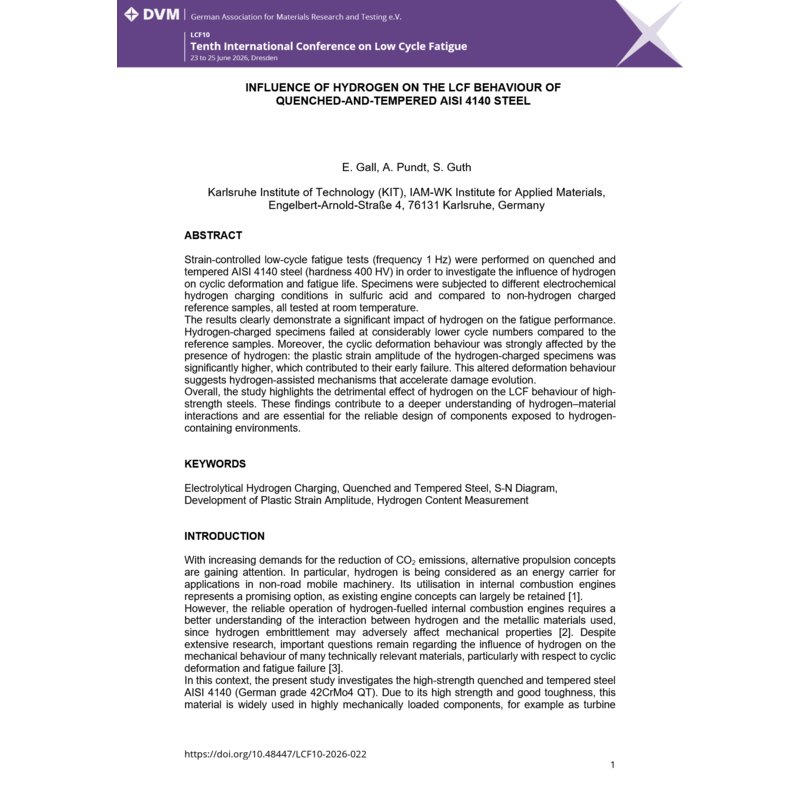
The results clearly demonstrate a significant impact of hydrogen on fatigue performance. Hydrogen-charged specimens failed at considerably lower cycle numbers compared to uncharged samples. Moreover, the cyclic deformation behavior was strongly affected: as shown in Figure 1, the plastic strain amplitude of hydrogen-charged specimens was consistently lower, indicating a suppression of cyclic plasticity. This altered deformation behavior suggests hydrogen-assisted mechanisms that accelerate damage evolution.
Fractographic analyses further revealed distinct differences between hydrogen-charged and uncharged specimens, supporting the conclusion that hydrogen plays a decisive role in crack initiation and propagation.
Overall, the study highlights the detrimental effect of hydrogen charging on the LCF behavior of high-strength steels. These findings contribute to a deeper understanding of hydrogen–material interactions and are essential for the reliable design of components exposed to hydrogen-containing environments.
Strain-controlled low-cycle fatigue tests (frequency 1Hz) were performed on quenched and tempered AISI 4140 steel (hardness 400 HV) in order to investigate the influence of hydrogen on cyclic deformation and fatigue life. Specimens were subjected to different hydrogen charging conditions via electrochemical loading in sulfuric acid and compared to uncharged reference samples, all tested at room temperature.
The results clearly demonstrate a significant impact of hydrogen on fatigue performance. Hydrogen-charged specimens failed at considerably lower cycle numbers compared to uncharged samples. Moreover, the cyclic deformation behavior was strongly affected: as shown in Figure 1, the plastic strain amplitude of hydrogen-charged specimens was consistently lower, indicating a…