
- Nur online erhältlich
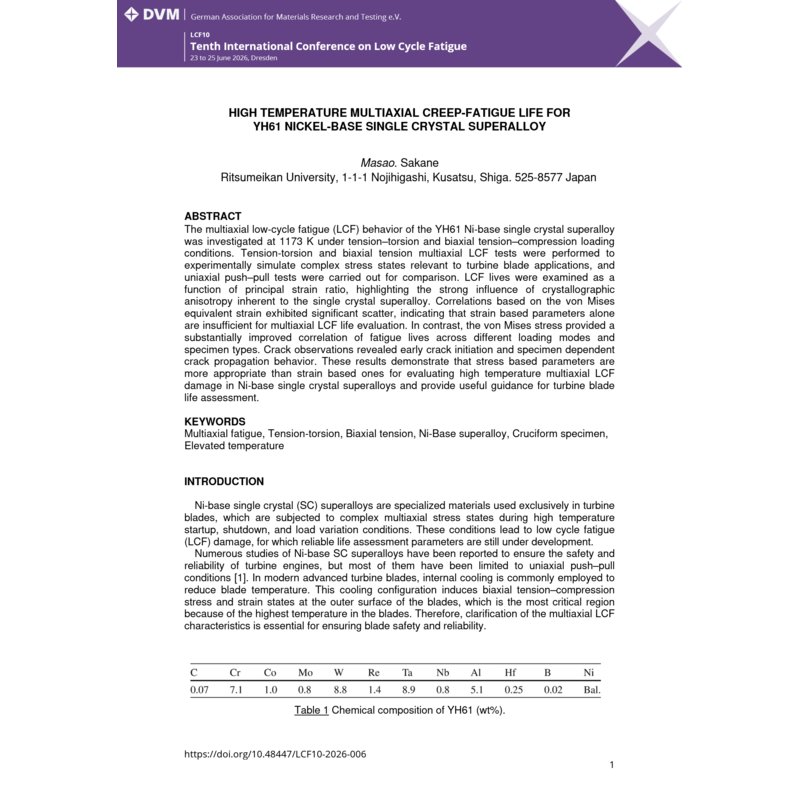
The objective of this study is to develop a creep-fatigue life estimate method for YH61 Ni-base single crystal superalloy under multiaxial stress states. Tension-torsion creep fatigue tests were performed using solid and hollow cylinder specimens of YH61 nickel-base single crystal superalloy. Biaxial-tension creep-fatigue tests were also performed using a cruciform specimen of which the shapes and dimensions are shown in Fig. 1. The creep-fatigue live of the three types of specimens showed significant anisotropic stress response depending on the crestal orientation which resulted in the large scatter in the correlation of the creep-fatigue lives with the conventional strain parameter.
The authors et al., [1] proposed the anisotropic strain which took account of the…

Datenschutzbedingungen (bearbeiten im Modul "Kundenvorteile")

Lieferbedingungen (bearbeiten im Modul "Kundenvorteile")

Rücksendebedingungen (bearbeiten im Modul "Kundenvorteile")
The objective of this study is to develop a creep-fatigue life estimate method for YH61 Ni-base single crystal superalloy under multiaxial stress states. Tension-torsion creep fatigue tests were performed using solid and hollow cylinder specimens of YH61 nickel-base single crystal superalloy. Biaxial-tension creep-fatigue tests were also performed using a cruciform specimen of which the shapes and dimensions are shown in Fig. 1. The creep-fatigue live of the three types of specimens showed significant anisotropic stress response depending on the crestal orientation which resulted in the large scatter in the correlation of the creep-fatigue lives with the conventional strain parameter.
The authors et al., [1] proposed the anisotropic strain which took account of the anisotropic stress response showed the better correlation. The frequency modified anisotropic strain was proposed to correlate the creep-fatigue lives of the superalloy, which took account of the creep effect as the frequency. The frequency modified anisotropic strain mostly correlated the creep-fatigue lives within a factor of two band but some creep-fatigue data were dropped off the scatter band. The correlation of the creep-fatigue data with the frequency modified Mises stress range, on the other hand, correlated all data within a factor of two scatter band, Fig. 2. In conclusion, in practical design of Ni-base single crystal superalloy, the frequency modified Mises stress is the first option to apply but the second option is to apply the frequency modified anisotropic strain if all stress components are difficult to estimate.
The objective of this study is to develop a creep-fatigue life estimate method for YH61 Ni-base single crystal superalloy under multiaxial stress states. Tension-torsion creep fatigue tests were performed using solid and hollow cylinder specimens of YH61 nickel-base single crystal superalloy. Biaxial-tension creep-fatigue tests were also performed using a cruciform specimen of which the shapes and dimensions are shown in Fig. 1. The creep-fatigue live of the three types of specimens showed significant anisotropic stress response depending on the crestal orientation which resulted in the large scatter in the correlation of the creep-fatigue lives with the conventional strain parameter.
The authors et al., [1] proposed the anisotropic strain which took account of the…