
- Nur online erhältlich
Conventional quenching and tempering of high-alloyed tool steels is used to balance their strength and toughness. However, in high carbon steels significant amounts of retained austenite remain after this kind of heat treatments, which decreases dimensional stability. Deep cryogenic treatments (DCT) at temperatures between -160 °C and -196 °C, being below the martensite finish temperature of these steels, lead to a transformation of the retained austenite into martensite. Moreover, DCT promotes carbide precipitation and refines the martensitic matrix. Although DCT is widely used to improve the performance of tool steels, its effect on the fatigue behaviour, and especially the cyclic deformation behaviour, is not yet fully understood. In this context also the influence of variations…

Datenschutzbedingungen (bearbeiten im Modul "Kundenvorteile")

Lieferbedingungen (bearbeiten im Modul "Kundenvorteile")

Rücksendebedingungen (bearbeiten im Modul "Kundenvorteile")
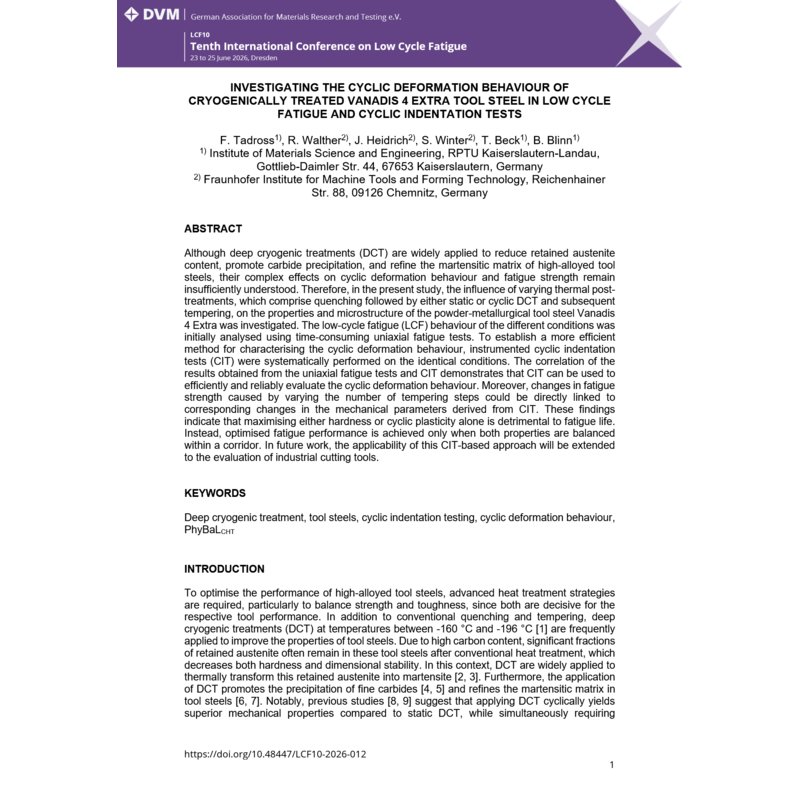
Conventional quenching and tempering of high-alloyed tool steels is used to balance their strength and toughness. However, in high carbon steels significant amounts of retained austenite remain after this kind of heat treatments, which decreases dimensional stability. Deep cryogenic treatments (DCT) at temperatures between -160 °C and -196 °C, being below the martensite finish temperature of these steels, lead to a transformation of the retained austenite into martensite. Moreover, DCT promotes carbide precipitation and refines the martensitic matrix. Although DCT is widely used to improve the performance of tool steels, its effect on the fatigue behaviour, and especially the cyclic deformation behaviour, is not yet fully understood. In this context also the influence of variations in the numerous process parameters, such as the duration of the DCT process or its position in the process chain (before or after tempering), must be analysed.
In previous work [1] on the effect of DCT processes on the performance of blanking tools, the cyclic properties were successfully characterised by instrumented cyclic indentation tests (CIT), in which the indentation force F and depth h were continuously measured. In accordance with [2], an F-h hysteresis is formed in the CIT cycles N from which the indentation depth amplitude ha,p is derived, representing the plastic deformation in each cycle. The resulting ha,p-N curves enable an efficient characterisation of the cyclic deformation behaviour of a material. Consequently, the CIT can be used to investigate the influence of a wide range of process variations on the cyclic deformation behaviour.
At this background, the present work investigates the influence of different cryogenic treatment strategies on the low-cycle fatigue (LCF) behaviour of the high-alloyed tool steel Vanadis 4E. The varied parameters include the tempering temperature, the position of the DCT process within the heat treatment sequence, and the application of static or cyclic cryogenic treatments, with the latter resulting in a shorter process time. The results show that DCT generally increases cyclic plasticity (see Fig. 1a), which correlates to the higher toughness reported for cryogenically treated tool steels [3]. Furthermore, variations in cryogenic treatment led to significant differences in cyclic deformation behaviour (see Fig. 1a).
In addition to the LCF tests, CIT were performed for the different treatment conditions. A strong correlation was observed between the cyclic deformation curves obtained from LCF tests and the ha,p-N curves derived from CIT (see Fig. 1). This underlines the potential of CIT as an efficient short-time method to analyse the effects of cryogenic treatment variations on the cyclic properties. Based on the CIT analyses, a large number of different conditions of cryogenically treated Vanadis 4E were investigated, revealing a strong influence of the interaction between the positioning of DCT and the tempering temperature on the cyclic properties.
Conventional quenching and tempering of high-alloyed tool steels is used to balance their strength and toughness. However, in high carbon steels significant amounts of retained austenite remain after this kind of heat treatments, which decreases dimensional stability. Deep cryogenic treatments (DCT) at temperatures between -160 °C and -196 °C, being below the martensite finish temperature of these steels, lead to a transformation of the retained austenite into martensite. Moreover, DCT promotes carbide precipitation and refines the martensitic matrix. Although DCT is widely used to improve the performance of tool steels, its effect on the fatigue behaviour, and especially the cyclic deformation behaviour, is not yet fully understood. In this context also the influence of variations…