
- Nur online erhältlich
High local stresses significantly reduce fatigue strength, particularly in welded joints. For the computational fatigue life assessment of such components, fracture mechanics is generally regarded as a suitable and physically well-founded approach. In practical applications, however, the use of fracture mechanics is often limited to concepts of linear elastic fracture mechanics, whose underlying assumptions are only partially fulfilled under loading conditions with pronounced plastic strain components, as typically encountered in the low-cycle fatigue regime.
Against this background, a fracture-mechanics-based framework for the fatigue assessment of welded joints was developed within the German research project IBESS. The IBESS approach describes a comprehensive assessment…

Datenschutzbedingungen (bearbeiten im Modul "Kundenvorteile")

Lieferbedingungen (bearbeiten im Modul "Kundenvorteile")

Rücksendebedingungen (bearbeiten im Modul "Kundenvorteile")
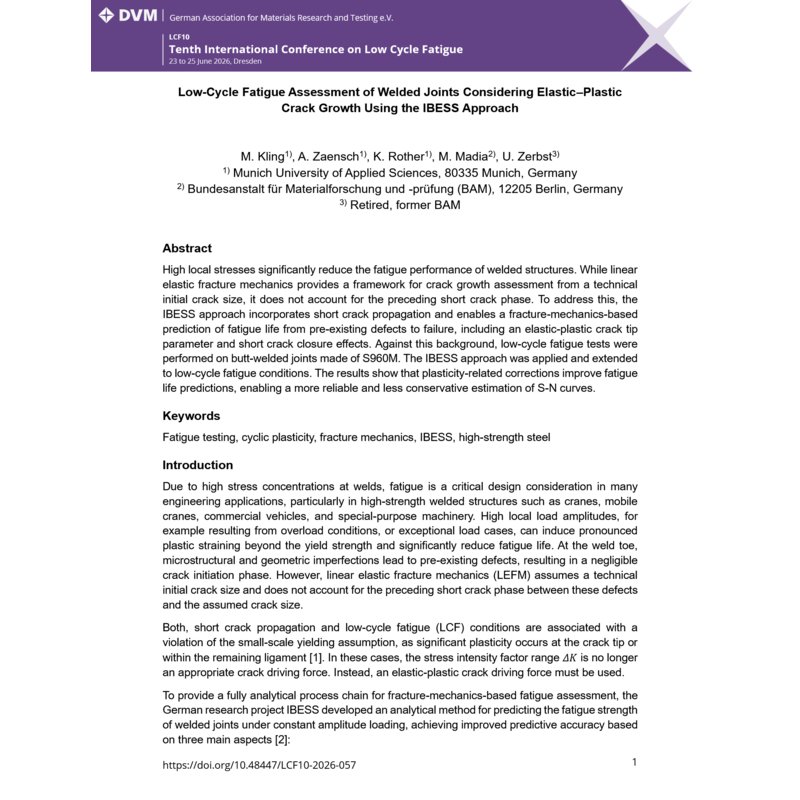
High local stresses significantly reduce fatigue strength, particularly in welded joints. For the computational fatigue life assessment of such components, fracture mechanics is generally regarded as a suitable and physically well-founded approach. In practical applications, however, the use of fracture mechanics is often limited to concepts of linear elastic fracture mechanics, whose underlying assumptions are only partially fulfilled under loading conditions with pronounced plastic strain components, as typically encountered in the low-cycle fatigue regime.
Against this background, a fracture-mechanics-based framework for the fatigue assessment of welded joints was developed within the German research project IBESS. The IBESS approach describes a comprehensive assessment procedure based on short crack propagation and the consideration of crack closure effects, while explicitly accounting for elastic-plastic crack growth mechanisms. Under loading conditions with high local stresses and strains, the consideration of cyclic plasticity becomes of particular importance.
In this contribution, the applicability of the IBESS approach to welded butt joints made of high-strength steel under high load amplitudes is investigated. For this purpose, constant-amplitude fatigue tests were conducted, in which pronounced plastic strain components occur. Based on the experimental results, a complete fracture-mechanical assessment using the IBESS approach was performed to estimate fatigue life spanning from low to high-cycle fatigue.
The results show that considering multiple crack growth and, in particular, applying plasticity-related correction leads to a significant improvement in the accuracy of fatigue life predictions under these loading conditions compared to linear elastic fracture mechanics. Thus, the fundamental applicability of the IBESS approach is confirmed also for loading conditions with pronounced plastic strain components in the low-cycle fatigue regime.
High local stresses significantly reduce fatigue strength, particularly in welded joints. For the computational fatigue life assessment of such components, fracture mechanics is generally regarded as a suitable and physically well-founded approach. In practical applications, however, the use of fracture mechanics is often limited to concepts of linear elastic fracture mechanics, whose underlying assumptions are only partially fulfilled under loading conditions with pronounced plastic strain components, as typically encountered in the low-cycle fatigue regime.
Against this background, a fracture-mechanics-based framework for the fatigue assessment of welded joints was developed within the German research project IBESS. The IBESS approach describes a comprehensive assessment…