
- Nur online erhältlich
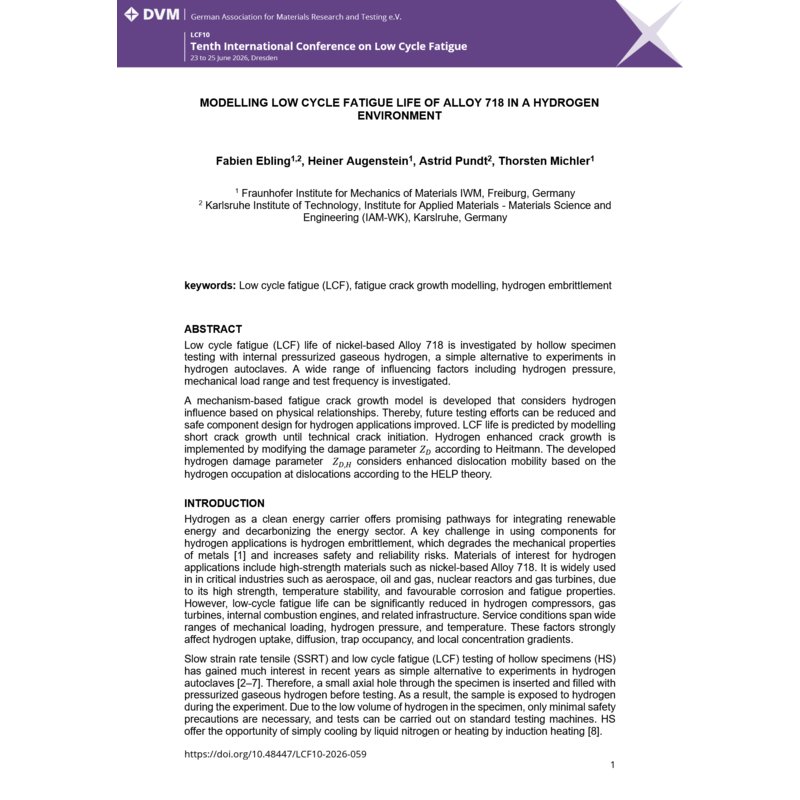
Hydrogen supports decarbonization by reducing emissions, facilitating renewable integration, and serving as a clean energy carrier. A key challenge is hydrogen embrittlement, which degrades the mechanical properties of metals and increases safety and reliability risks. Low-cycle fatigue life can be significantly reduced in hydrogen compressors, gas turbines, internal combustion engines, and related infrastructure. Service conditions span wide ranges of mechanical loading, hydrogen pressure, and temperature. These factors strongly affect hydrogen uptake, diffusion, trap occupancy, and local concentration gradients, thereby driving damage evolution and making predictive, physics-based models essential for safe component design while reducing testing effort.
To investigate…

Datenschutzbedingungen (bearbeiten im Modul "Kundenvorteile")

Lieferbedingungen (bearbeiten im Modul "Kundenvorteile")

Rücksendebedingungen (bearbeiten im Modul "Kundenvorteile")
Hydrogen supports decarbonization by reducing emissions, facilitating renewable integration, and serving as a clean energy carrier. A key challenge is hydrogen embrittlement, which degrades the mechanical properties of metals and increases safety and reliability risks. Low-cycle fatigue life can be significantly reduced in hydrogen compressors, gas turbines, internal combustion engines, and related infrastructure. Service conditions span wide ranges of mechanical loading, hydrogen pressure, and temperature. These factors strongly affect hydrogen uptake, diffusion, trap occupancy, and local concentration gradients, thereby driving damage evolution and making predictive, physics-based models essential for safe component design while reducing testing effort.
To investigate hydrogen effects efficiently and safely, the hollow specimen technique provides a robust experimental approach. A specimen with an axial hole allows controlled hydrogen introduction during fatigue testing while limiting the amount of hydrogen during test and associated risk. The hollow design also enables efficient cryogenic cooling with liquid nitrogen and heating via induction, supporting tests over a broad temperature range. This method has been used to assess the low-cycle fatigue behavior of nickel-based superalloy 718, which offers high strength, corrosion resistance, and creep resistance at elevated temperatures and is widely deployed in aerospace, oil and gas, and chemical processing.
A predictive model is formulated for the low-cycle fatigue regime under diverse operating conditions, extending Heitmann’s ZD damage parameter to the hydrogen-specific damage parameter ZHD to capture hydrogen-induced damage. The approach focuses on short crack growth to determine the cycles to technical crack initiation. The hydrogen damage parameter ZHD extends ZD with a hydrogen environment sensitive term that couples cyclic plastic damage with local hydrogen phenomena ahead of the crack tip, including hydrogen diffusion and trap kinetics at dislocations. Temperature, hydrogen pressure, and loading frequency enter through transport and trapping parameters that reflect realistic service conditions.
Validation against experiments on hollow specimens in hydrogen shows very good agreement in lifetime prediction and damage evolution. Across a range of pressures, temperatures, strain ranges and test frequencies, ZHD reproduces the observed acceleration of crack growth with hydrogen. These results confirm that the model captures the interaction between cyclic plasticity and environmental conditions, providing a robust basis for safe design, qualification, and life management of components in hydrogen applications.
Hydrogen supports decarbonization by reducing emissions, facilitating renewable integration, and serving as a clean energy carrier. A key challenge is hydrogen embrittlement, which degrades the mechanical properties of metals and increases safety and reliability risks. Low-cycle fatigue life can be significantly reduced in hydrogen compressors, gas turbines, internal combustion engines, and related infrastructure. Service conditions span wide ranges of mechanical loading, hydrogen pressure, and temperature. These factors strongly affect hydrogen uptake, diffusion, trap occupancy, and local concentration gradients, thereby driving damage evolution and making predictive, physics-based models essential for safe component design while reducing testing effort.
To investigate…